
Unbecoming: The Lost and Obsolete Versions of 'Manhunter'
Or, how and why Michael Mann's cult classic changed over 40 years

Many different cuts of director Michael Mann’s artsy 1986 Hannibal Lecter thriller Manhunter have been know to exist, yet outside of the theatrical cut, almost none of them are available today for mass distribution. Their ephemerality, coupled with the fact that multiple releases have been defined and marketed as Mann’s ‘director’s cut,’ has led to a great deal of audience confusion and consternation.
Why are there so many cuts? Why does Mann keep changing and reissuing the film?
In this article, I outline the history of the lost, replaced, and obsolete versions of Manhunter, showing how they led up to the latest version currently declared “final.”
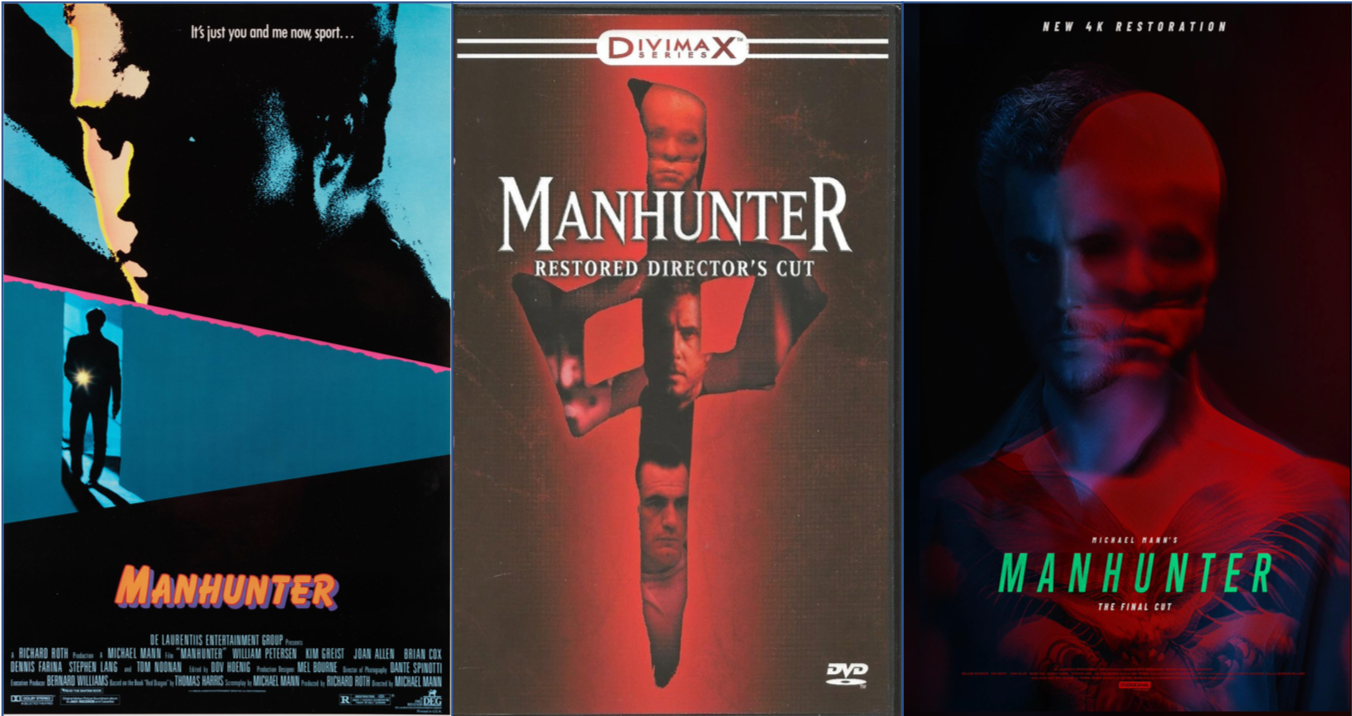
By documenting when and why these versions came to exist, I intend to clarify how the film in general, and Mann’s vision for his director’s cut in particular, changed over time. In the process, I hope to better contextualize the film’s textual instability and improve public understanding of the director’s ongoing revisionism.
Table of Contents
‘Manhunter’ Version Chart
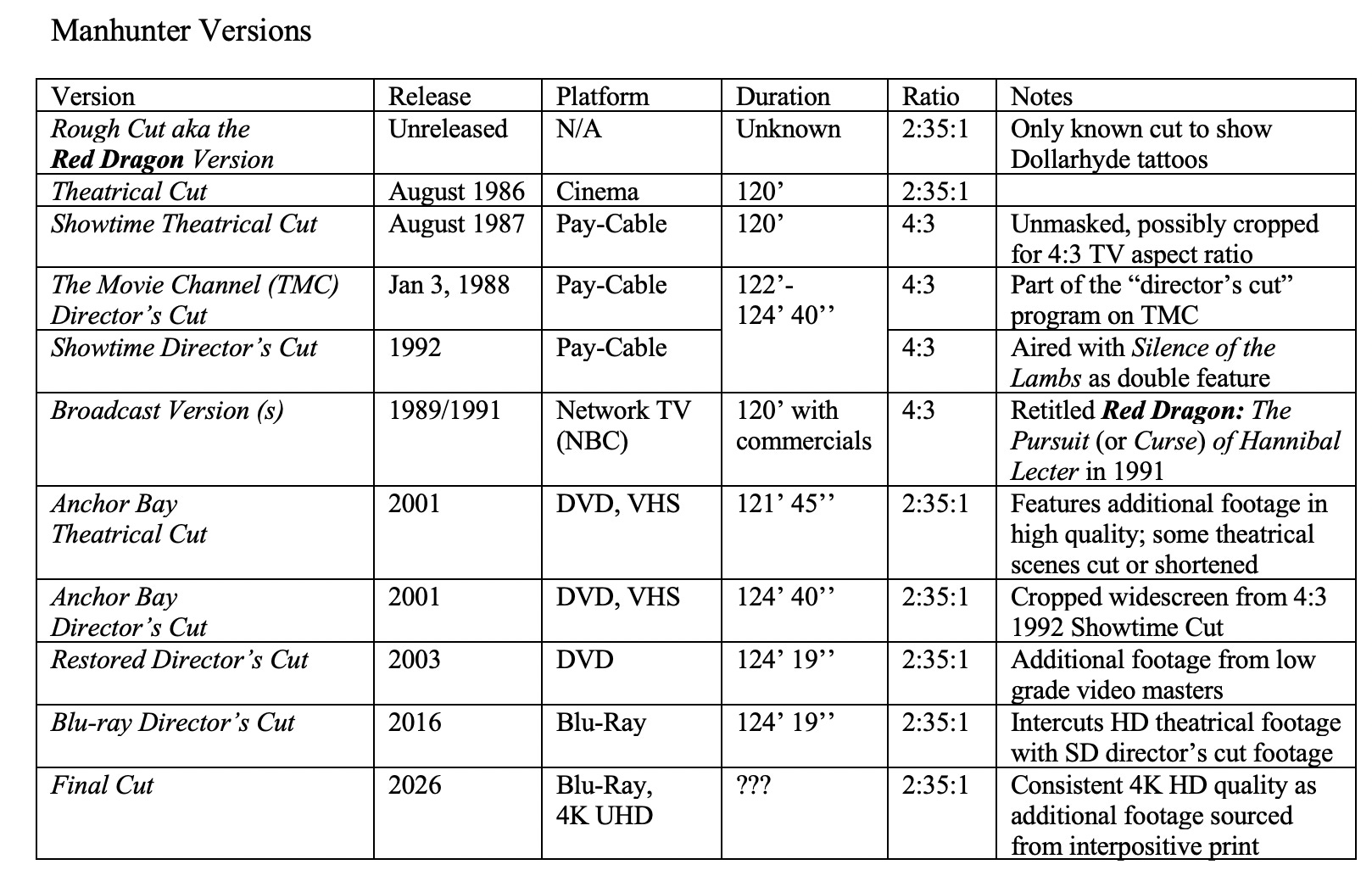
The following chart provides a quick summary of the versions I will discuss.
The Unseen “Red Dragon” Cut
Unlike many other films that have received a post-theatrical director’s cut, Manhunter was not marked by extensive behind-the-scenes conflicts or creative differences over the editing of the theatrical release. Though Mann had to change the film’s title Red Dragon at the insistence of producer Dino DeLaurentiis partway through post-production, he’s repeatedly claimed to have otherwise had complete control over it.
“I wanted to call it “Red Dragon” and that is the one part of this motion picture that I was overruled by Dino DeLaurentiis… Dino had a picture called “Year of the Dragon” and Dino feared the picture would be confused with that… So, we had many arguments which were hilariously funny… and in the end, we wound up calling it Manhunter. … we should’ve called it Red Dragon.”
Source: Michael Mann, Audio Commentary on the 2003 Manhunter: Restored Director’s Cut DVD, [1:24:22]
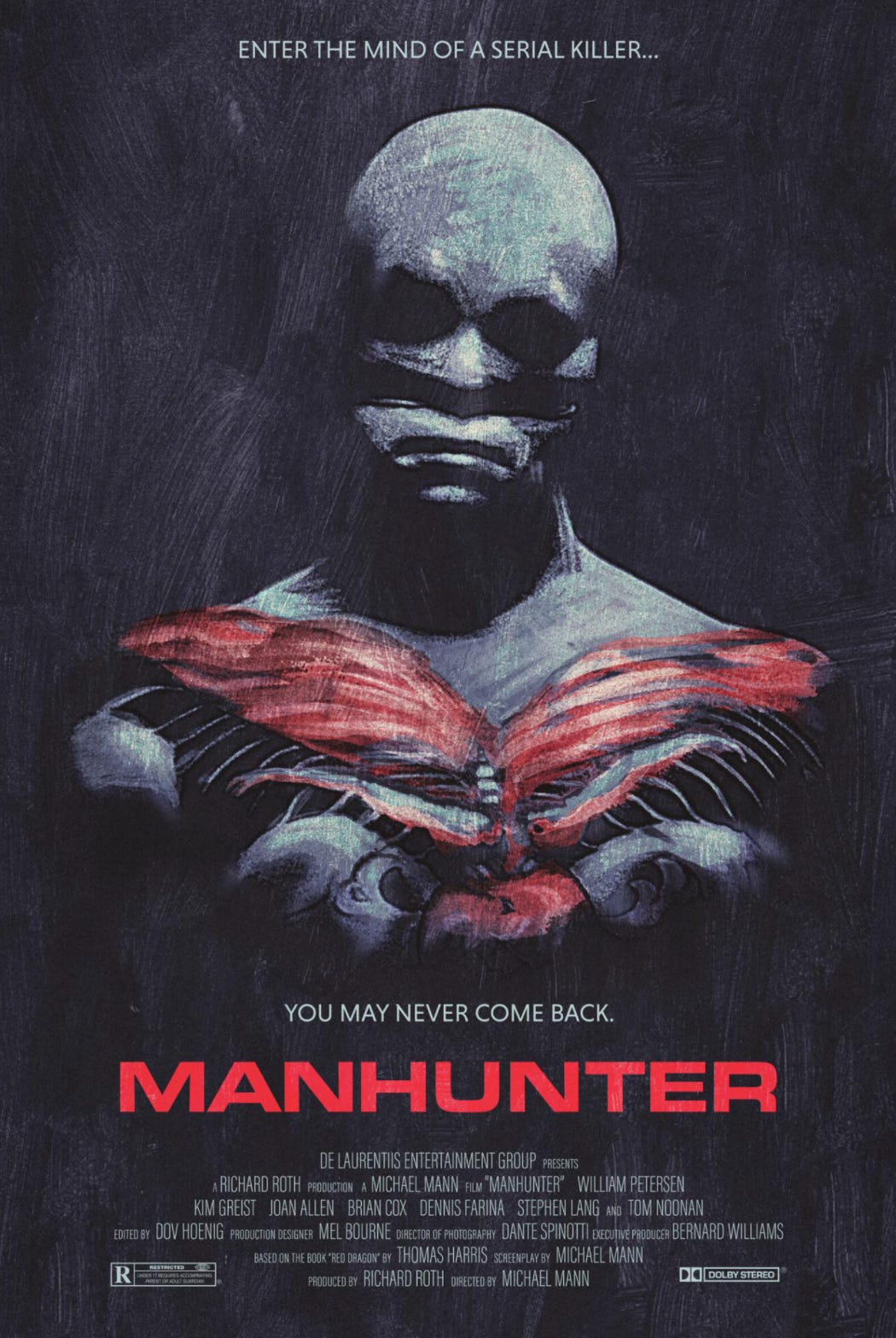
Nonetheless, the film had undergone an interesting shift prior to release, one that became evident due to the distributor leaking to the press some still photographs from two scenes featuring the film’s antagonist Francis Dollarhyde (Tom Noonan) shirtless and clad in tattoos of the Red Dragon, in reference to the William Blake painting “The Great Red Dragon and the Woman Clothed with the Sun.”*
*Specifically, these were the scene where Dollarhyde reveals himself to Freddie Lounds, and a later scene when he lies in bed with Reba McLane.
The tattoos themselves never appeared in the film itself, signifying the existence of a pre-release cut of Manhunter that was more faithful to the literary source material.*
*The elaborate body tattoos are a key element of the Dolarhyde character in the original novel by Thomas Harris and are foregrounded in both the 2001 film adaptation by Brett Rattner and the third season of the 2013 television adaptation by Bryan Fuller.
To date, the alternate scenes of Dollarhyde have never been released to the public, either as a separate supplement or as part of an alternate cut, even as the image of tattooed Dollarhyde has over the years come to adorn multiple posters, cover arts and other promotional materials pertaining to Manhunter.
A Sept/Oct 1992 Video Watchdog article called “The Unseen MANHUNTER” by Paul Sammon, a former promotions manager at DEG and one of the few journalists privy to its early script drafts and its rough cut, offers one of the only inside looks at this unseen version and analyzes how different it was from the theatrical release.
Per Sammon, this version made much more explicit the notion that Dollarhyde committed murders in an attempt to essentially transform himself into the Red Dragon of Blake’s painting, that he was basically becoming the Dragon over the course of the film, with his original personality being subsumed by the new one.
As he puts it:
“While the existing versions of MANHUNTER suggest Dollarhyde’s obsessive fIxation on Blake’s painting, Harris’ novel made it abundantly clear that Dollarhyde’s murderous actions were actually a psychotic effort to merge his personality with the Red Dragon of Blake’s work. The unseen MANHUNTER underlined this fact via two shots cut from the release print, deleted segments that further clarified Dollarhyde’s delusional quest to become the Red Dragon of Blake’s painting.”
Source: Paul Sammon, “The Unseen MANHUNTER: The Slaying of RED DRAGON,” Video Watchdog 13 (Sept/Oct 1992): p.32
The first shot appeared about 56m 20s into the film, where Dollarhyde reveals himself to Freddie Lounds, saying: “Well, here I am.” In the theatrical cut, Dollarhyde appears in a pantyhose wearing a blue shirt. But the Pre-Release version featured him shirtless with the Red Dragon tattoo prominently displayed across the chest and back. This striking visual image foregrounded Dollarhyde’s becoming the Dragon.
The second shot featured additional dialogue between Dollarhyde and Reba McLane near the film’s end, about 102 minutes into the theatrical version, where Dollarhyde puts his hand on Reba’s mouth before speaking of the Red Dragon and how he “changed the two groups of people.”
The cut exchange, according to Sammon, indicates “...the slow erosion of DoIlarhyde’s personality, one that has now been completely usurped by the Red Dragon.” (32)
Sammon can only speculate as to why both explicit references to the Red Dragon were removed from the theatrical version. One possibility is that this was a ‘casualty’ of the film’s title change from Red Dragon to Manhunter during the course of post-production. Another is that Mann himself came to feel in the course of editing that such an image “was now out-of-synch with the more subtle approach” the film took to the depiction of the character and his identification with the painting. (34)
The latter interpretation is given credence by interviews with Michael Mann and Tom Noonan, who claim that the change was Mann’s personal aesthetic choice, rather than something forced upon him. That is, Mann’s vision had evolved, with him coming to believe the tattoos were ultimately unnecessary. Tellingly, Mann never reinstated the alternate scenes and cut dialogue about the Dragon in any subsequent re-issue.
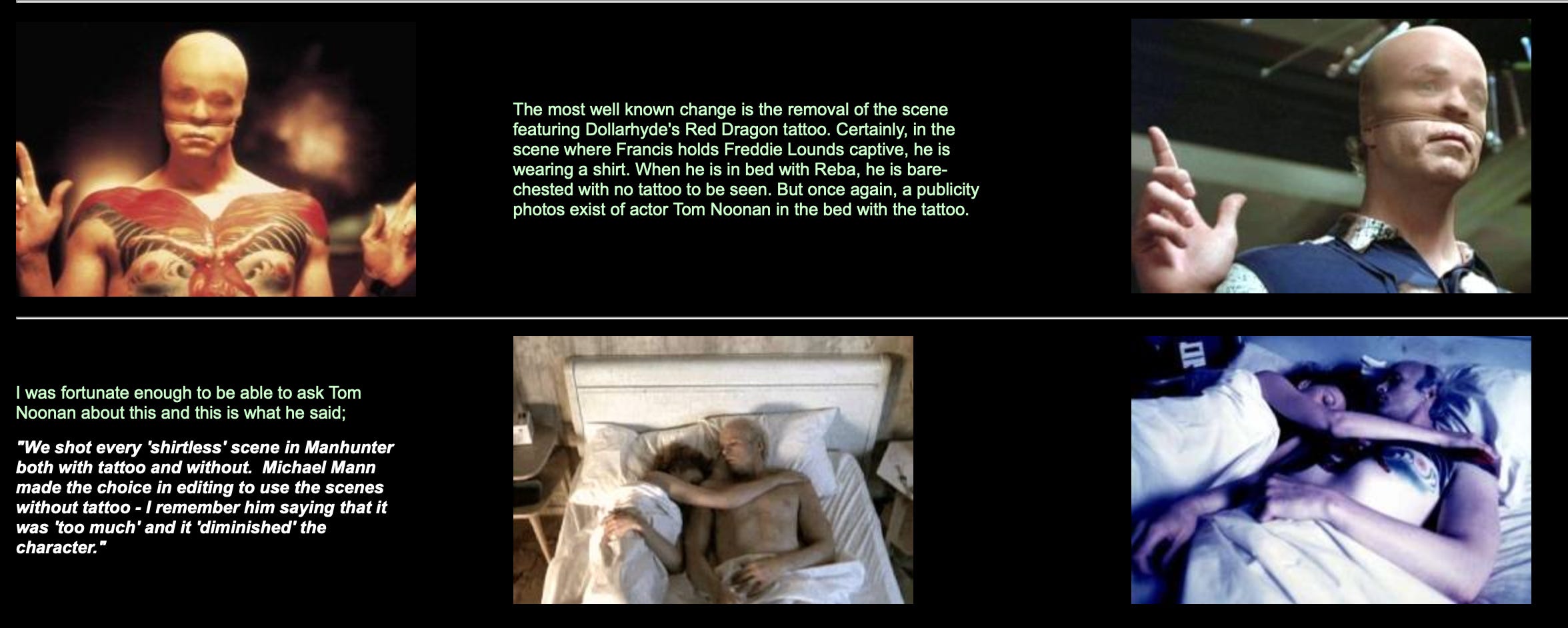
For instance, here is what Mann says in response to a question from Cinefantastique in 1987 about whether or not he had cut scenes from the film when the interviewers bring up the photos of a tattooed Dollarhyde, who never appear in the film.
“Nothing was cut out. These photos you’ve seen come from the United States and should never have been sent to you. The American distributor screwed up in doing that. They are scenes that seemed pointless to us. Another shows Stephen Lang fried to a crisp and sitting in a wheelchair. Some idiots in Los Angeles sent along these proofs without even checking them out.”
Source: Alain Charlot and Marc Toullec, “Manhunter: An Interview with Michael Mann” from Cinefantastique, May (1987): 37–39. Quoted from Michael Mann: Interviews, 1980-2012, p. 50
And here’s what Noonan has said about the tattoos in a DVD interview, an excerpt from which has been uploaded to YouTube.
“And they started shooting the movie with this on me. One day he came to me and said: “I think the tattoo trivializes your struggle. And we’re not going to use it.”
Source: Tom Noonan, Inside Manhunter 2001 DVD Featurette
The shift from the pre-release cut to the theatrical version shows that Mann’s vision for the film was not set in stone and underwent a gradual evolution. And that evolution would continue long after the film’s theatrical run ended.
Please consider subscribing to receive new posts for free via email, or upgrading to a paid subscription to support this publication.
The Pay-Cable Cuts (1988-1992)
It was on Premium Cable that Mann first made some major authorial revisions to Manhunter. But to date, there are conflicting accounts over how many of them exist, when they came to be, and what the differences between them are. Some claim that since 1987, the film had a singular “director’s cut” that aired on cable several times over the years prior to coming to DVD in 2001. Meanwhile, per the Manhunter Complete Resource fansite, there were actually three distinct alternate Showtime cuts, of which only the last served as the “director’s cut“ on the DVD release.*
*Notably, however, the author does not distinguish between Showtime and The Movie Channel, seemingly referring to all the versions as Showtime Cuts.
What follows is what I believe to be the most accurate and precise account possible of how premium cable release led to the film’s circulation in multiple versions. It has been constructed using archival newspapers, magazines, and other sources.
The Showtime Theatrical Cut (1987)
In June 1986, Dino DeLaurentiis Entertainment Group (DEG) entered into an exclusive 10-film licensing agreement with Viacom subsidiary company Showtime-The Movie Channel Inc. Per this agreement, several of DEG’s recent feature films, including Raw Deal, Blue Velvet, and Manhunter - then still known as Red Dragon - would subsequently circulate throughout 1987-1988 only on the two premium cable networks belonging to the company: Showtime and The Movie Channel.1 In August 1987, about a year after its theatrical release, Manhunter began to air on Showtime.2
The resulting version could be what Manhunter Complete Resource refers to as the “First Showtime Cut,” which reportedly “…deleted the scene with Will on the dock after he shoots Dollarhyde and adds the scene with his visit to the next family.”
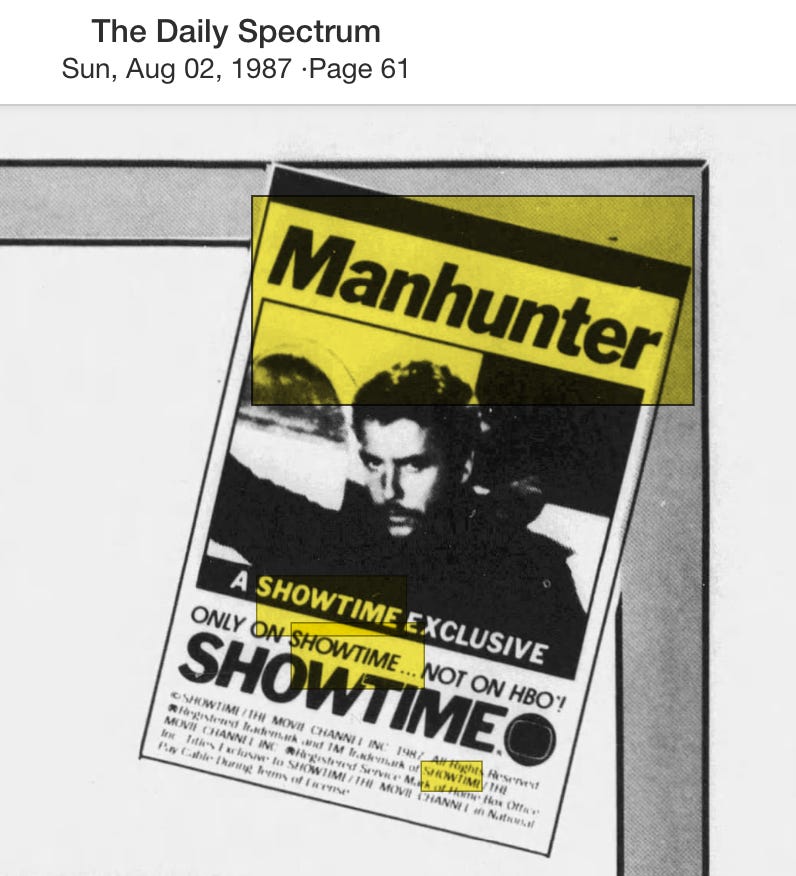
However, multiple other sources indicate that, editing-wise, this version was identical to the Theatrical Cut. I’ve found no corroborating evidence from the time period pointing to this being a revised version, and newspapers list its running time as 1h 59m, which more or less matches the duration of the original. My conclusion is that this first pay-cable version is indeed a Showtime Theatrical Cut, whose only truly notable difference from the original theatrical release was its 4:3 aspect ratio.
As Manhunter was shot in the “matted” widescreen format, this would’ve been done by removing the mattes that framed it for 2.35:1, exposing additional information at the top and bottom of the screen. The sides, however, would also need to be cropped in some way to fit the squarish TV frame.*
*Comparisons of the different aspect ratios can be seen here, courtesy of The Manhunter Resource fansite, which found that the 4:3 exposes the boom microphone in several scenes.
According to program listings from multiple 1987 archival newspapers, this version continued to air exclusively on Showtime throughout the rest of the year.
The Movie Channel Director’s Cut (1988)
On January 3, 1988 the film began to circulate on Showtime’s sister network The Movie Channel (TMC). Only in this case, it had been re-edited by Michael Mann to premiere as the first entry of a new “occasional Movie Channel feature” program called “Director’s Cut.”3 From what I’ve gathered, this was the first post-theatrical alternate cut of Manhunter ever made and historically may be the earliest instance of the term ‘director’s cut‘ being used to designate an authorial revision of this sort.
What prompted TMC to begin this “Director’s Cut” program is unclear, though I believe they might’ve been inspired by the growing popularity of alternate cuts throughout the 80s on the pay-cable Z-Channel and in the home video market.
As the title indicates, it provided filmmakers with “….the opportunity to re-edit their theatrical releases so that they closely resemble the director’s original vision.”4 One would think then that it intended to capitalize on the many instances of studio directors being dismayed at distributor meddling or the lack of final cut over theatrical releases.
But in this regard, Manhunter was something of an outlier, in that Mann had, by his own admission, full control over the film, with the exception of the title.
His rationale for making the new version was that he saw an opportunity to “go back to the editing room and take advantage of hindsight.”5 The director’s cut (DC) in this case then was a means of retroactively improving or ‘enhancing’ what came before.
“The Movie Channel is offering viewers a rare chance to see films re-edited by their directors…. “I always wanted to add a number of scenes that I felt would enhance the film, making the characters more complex with more of an emotional life than the original theatrical versions,” Mann said in a statement released by TMC.”
Source: Vidette-Messenger of Porter County (Valparaiso, Indiana) · Thu, Dec 31, 1987 · Page 24
““Some people ask why were some of these cuts made, what was the difference between the director’s version and other – there was, there was no external imposition of a studio or somebody saying: “Make it shorter….” What a lot of these extended director’s versions are – is actually a director’s ability to rethink and bring back a fuller form of the film and maybe a better form of the film.”
Source: Michael Mann, Audio Commentary at [56:00-56:25], Manhunter Restored Director’s Cut DVD, Anchor Bay Entertainment.
How long exactly the 1988 DC was and how much it differed from the other versions is currently unclear. TMC granted the new version a 2.5-hour time slot, but this doesn’t mean that it contained 30 minutes of extra footage. Some of the extra allotted half-hour was given over to the “Director’s Cut” program itself, which apparently featured an introduction by Mann. And after the DC finished airing, the remainder of the time slot would logically be filled up with commercials for other TMC broadcasts.
Without a doubt, the 1988 DC was longer than the 120-minute Theatrical Cut. And since none of the iterations of the ‘director’s cut’ that later released on video were longer than 124m 40s, we can assume that it was at most this length.
Evidently, the 1988 DC did not garner high ratings, for the “Director’s Cut” program it was part of never received another episode. Its cancellation, however, did not prevent the channel from re-circulating the Manhunter DC throughout the year.
Newspaper TV Guide listings indicate that Showtime also at some point during the year began to air the DC, giving it time slots of 2h 5m, 2h 10m, and 2h 30m. It’s possible that the channel alternated between showing it with the Theatrical Cut.
Manhunter continued to air up until December 31, 1988 on both channels.
Interlude: The Broadcast Versions (1989-1991)
By the end of the year, the exclusive licensing agreement had presumably expired, as afterwards the film seems to vanish from both channels before re-appearing in March 1989 on NBC in an edited broadcast version that had to fit into a two-hour time slot with commercials. For the next two-and-a-half years the film primarily (or perhaps exclusively) circulated on network TV.
In April 1991, NBC began re-airing Manhunter in a revised broadcast version called Red Dragon: The Pursuit of Hannibal Lecter. By May, NBC retitled it again to Red Dragon: The Curse of Hannibal Lecter. (Notably, on-screen, the film is called Red Dragon and has neither the ‘pursuit’ or ‘curse’ subtitles.)
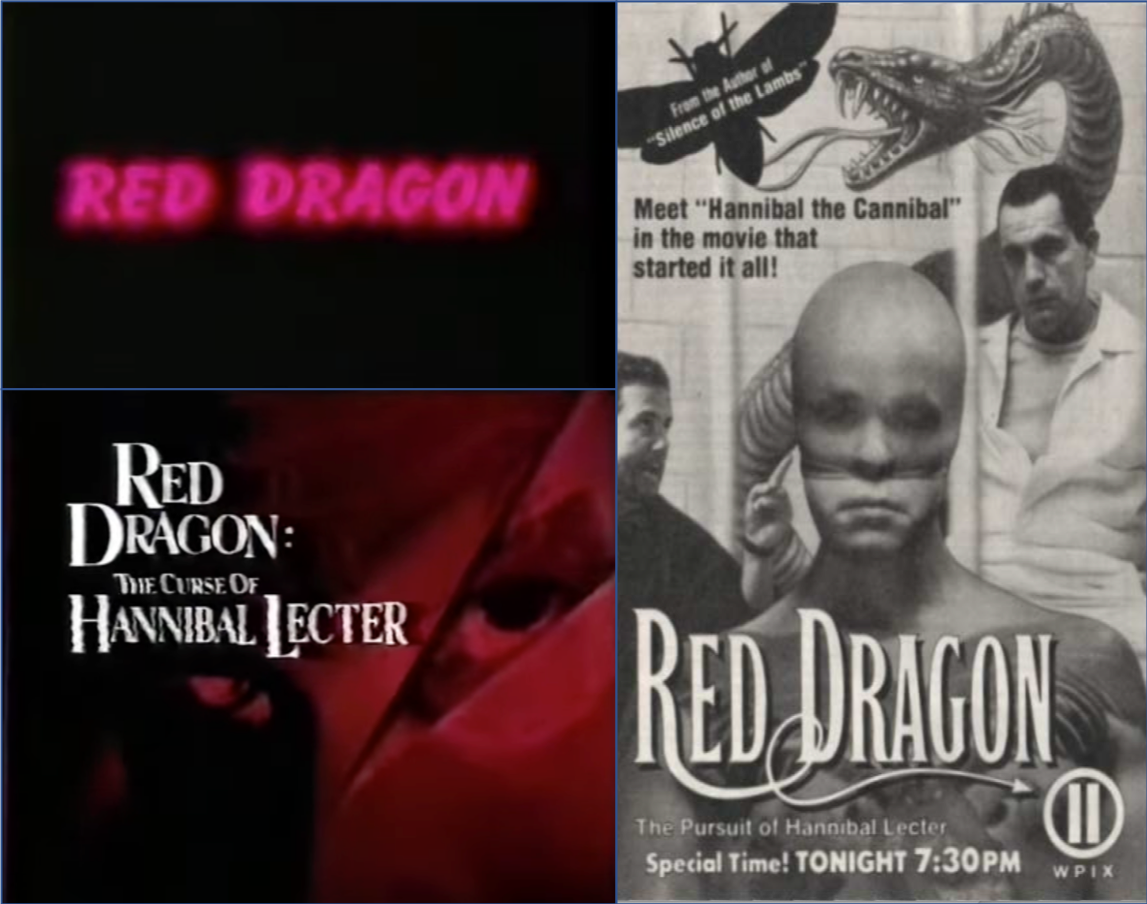
By NBC’s own admission, this was done to capitalize on the massive popula-rity of the Lecter character following the release of Silence of the Lambs (1991, dir. Jonathan Demme), an adaptation of another Thomas Harris novel that was a standalone sequel to Red Dragon, the basis of Manhunter.
A promotional video along with the opening credits for this version can be seen on YouTube. It suggests that the broadcast versions were both derived from the 1988 DC, as outside the different title screen, they have virtually identical opening credits, which were distinct from the theatrical version.
The Showtime Director’s Cut (1992)
Manhunter seemed to remain absent from pay-cable until November 1991, when it returned to The Movie Channel. Little information is available about these airings, though program listings suggest TMC may have showed both preceding cable cuts.
About five months later Showtime decided to similarly cash in on the Lecter hype by repackaging Manhunter as part of a “Hannibal the Cannibal double feature,” which showed it back-to-back with Silence in one evening. The Showtime premiere of Silence was followed by the “director’s cut” of Manhunter on March 1, 1992. It recurred several times throughout the month, though with the order of the films being flipped.*
* You can watch a clip from this double feature, which included original Showtime introduction sequences to each respective movie here.
It’s difficult to say with absolute certainty, whether or not this 1992 Showtime DC was identical to the 1988 TMC version, as different sources say different things.
The double feature promotions indicate that this cut only had two additional minutes of footage. However, newspapers list it as being 125 minutes long, while Tim Lucas’ 1992 Video Watchdog comparative article on the cable version claims that its running time was 124m and 24s.6 The Manhunter Resource site’s description of it matches Lucas’ description of the changes but positions the edition as distinct from the previous two Showtime Cuts. Nonetheless, the general consensus is that this cut’s assemblage would be replicated by the 2001 DVD director’s cut from Anchor Bay. This means the 1992 version was at least 122 minutes long and at most 124m 40s long.
Given Mann’s tendency to make minor, virtually imperceptible changes to his movies in general and Manhunter in particular, I assume that there were tiny editing differen-ces between the 1988 TMC and 1992 Showtime Cuts, and so will consider them to be two distinct cuts going forward, with the former serving as the basis of the latter.
If so, one can infer that the 1992 version was the latest iteration of the director’s cut and replaced the 1988 version. It itself, in turn, would be replaced about 10 years later.
Anchor Bay DVD Versions (2001-2003)
To expand on an earlier point, the rise of the Pay-Cable, VHS, and Laserdisc markets in the late 80s was one of the primary reasons for the production of post-theatrical alternate cuts, especially authorial revisions typically labelled the “director’s cut.”
The mass consumer adoption of the DVD format, which premiered in 1997, likewise led to a proliferation of authorial revisions of both older and newer films. At the height of DVD’s popularity (arguably 2001-2007), alternate versions helped legitimize the format as one that allowed auteurs to realize their true visions on the home screen.
This coincided with a resurgence of interest in the Hannibal Lecter novels by Thomas Harris, who had after several years of delays released a sequel to Silence of the Lambs aptly called Hannibal in 1999. Whereas Lecter (Anthony Hopkins) was a secondary character in the previous works, here he was front and center. A maligned film adaptation of Hannibal directed by Ridley Scott came out in 2001, followed by a better received re-adaptation of Red Dragon in 2002 courtesy of Brett Rattner.
All this created the economic preconditions for once again reissuing Manhunter.
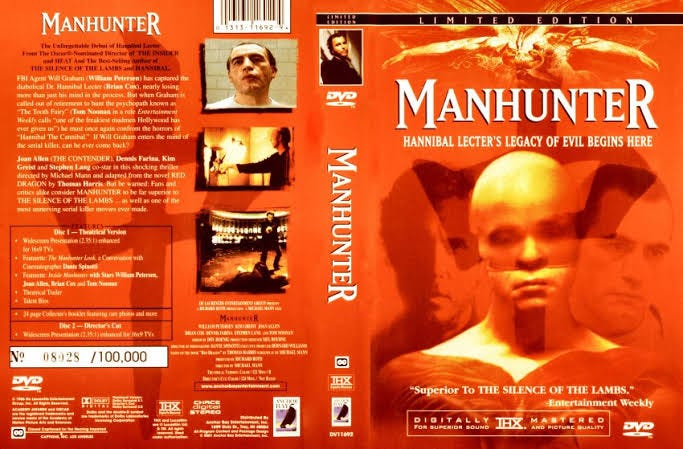
On January 30, 2001 - about 10 days before the theatrical release of Hannibal - Anchor Bay Entertainment, a Michigan-based distributor celebrated for “resurrecting titles that have fallen out of circulation” in the new DVD format reissued Manhunter in two DVD editions. The regular edition only carried the film’s theatrical cut, while the more expensive 2-disc “limited edition” purportedly included both the theatrical version and the director’s cut, along with additional exclusive special features.
In reality, however, what Anchor Bay ended up releasing were two new versions of the movie. Both would prove controversial, though for different reasons.
Anchor Bay Director’s Cut (2001)
The Anchor Bay DC was at the time of release the longest commercially accessible cut of the film. Running 124m 40s, it features about 12 minutes of previously unseen footage, but it also removes about 7m 20s from the theatrical cut by pruning many extant dialogue scenes. I haven’t been able to verify if there were any editorial differences between it and its predecessor version(s). But every new scene mentioned by Tim Lucas in his 1992 article on the Cable Version appears in it, while its opening title and credits sequence match those of the 1992 Showtime Cut.
The only real difference then lies in the aspect ratio. Where the Showtime Cut was shown in an unmatted and cropped 4:3 ratio that allowed the image to fill in the TV screen, the Anchor Bay DC is presented in 2:35:1 widescreen.
The problem, however, is that, rather than use source footage, which was composed in and matted for 2.35:1, Anchor Bay apparently cropped it out of the 4:3 Showtime Cut, which had already lost a good chunk of the image in the transition to TV. Because the 2:35:1 frame of this version is actually faked, the end result then is missing even more of the image: both on the sides and at the top and bottom. This, in turn, likely required reframing the image to keep certain details, such as character faces, in focus.
Compounding the numerous resulting framing issues is the overall low video quality.
The transfer apparently was not optimized to take advantage of the higher resolution levels made possible by DVD, having been sourced from what Mann himself would later describe as an “inferior 1-inch master” videotape copy. That is, there was no high-quality celluloid source material for the additional director’s cut footage.
“Anchor Bay had used a cut that, while good, came from an inferior one inch master that Mann said had been “just lying around.””
Source: Enrique Rivero, “’Dragon’ predecessor ‘Manhunter’ is redone” Video Store Magazine 25 Issue 14 (Mar 30-Apr 5, 2003): 8, 25
Unsurprisingly, critical reactions to the technical presentation of the Anchor Bay DC were negative, especially when compared with that of the “theatrical version,” which was provided a high-quality THX certified digital video transfer (and whose video master copy was almost certainly derived from high-quality celluloid source material).
Here are some quotes:
“ As for the longer director’s cut ... the video quality is noticeably worse than the standard cut, making it an iffy proposition…. It almost looks like it came from a video source, and quite frankly I found it almost unwatchable.”
Source: Peter M. Bracke on the Director’s Cut video quality, Manhunter Limited Edition DVD Review, DVDFile, Jan 8 2001.
“The theatrical version comes in a clean THX-certified video transfer with a 5.1 audio remix that should delight the film’s loyal core of fans. The same, however, can’t be said of the longer director’s cut, which is fuzzy and washed out and includes only Dolby Digital 2.0 sound.”
Source: Enrique Rivero, “A Feast for Anchor Bay,” Video Business 21, no. 8 (Feb 19, 2001): 38.
“The anamorphic presentation is starkly beautiful, with a full-sounding, THX-approved Dolby Digital 5.1 score. But the additional director’s cut takes on a muddy video transferred look that doesn’t do the film justice - additional footage or not.”
Source: Todd Doogan, Video Store Magazine (Jan 28-Feb 3, 2001): 31.
“... the framing has been badly altered and it does not replicate the shots found on the theatrical cut. Not a single shot of the DC is framed correctly, though some instances are more blatant than others…. It seems obvious that this picture came from a VHS copy of the movie as it looks absolutely terrible. ”
Source: Colin Jacobson, “Manhunter: Limited Edition (1986) Review,” DVD Movie Guide, http://www.dvdmg.com/manhunterle.shtml. No date
Whether or not the editing of the new version stayed true to the vision and intentions of Michael Mann, or made for a better film in this case mattered less than the fact that the ‘director’s cut’ had failed the audiovisual standards of DVD.


Anchor Bay Theatrical Cut (2001)
The Anchor Bay “Theatrical Cut,” by contrast, had something of an inverse problem. Though its audiovisual quality was appropriate to the technical demands of the DVD format, its assemblage was NOT identical to that of the actual theatrical version.
On the one hand, it was missing about 1m 33s from the theatrical cut. On the other, it had added two new sequences and a short extension, worth about 3m 18s of additional footage, that were previously exclusive to the 1992 Showtime Cut. This is why it is 121m 45s long and is nowadays also referred to as the “hybrid cut.”*
*I would personally add that it contains some unique elements that don’t seem to appear in any other version of the film released on video, such as the presence of a GREEN color grade in the opening murder scene, which is also not blurred or made to look like a VHS recording.
How exactly this version came into the possession of Anchor Bay and made its way to DVD under the label of the ‘theatrical cut’ has, to my knowledge, never been officially explained. Speculation suggests that Anchor Bay used an early workprint version of the movie as the celluloid source material for its video transfer. I think, however, it is far more likely that Anchor Bay received what seemed to be a finished and complete high-quality celluloid print (probably an interpositive, as the original negative was apparently lost at the time) from whoever actually owned the film at the time, and the sender failed to realize the print didn’t contain the actual theatrical version.
This implies that this was a version that was made very close to the end of the film’s original post-production process, rather than a traditional early “workprint,” which wouldn’t have had finalized post-production elements, such as sound and music.
I strongly suspect that everyone involved was deeply embarrassed by the snafu, and so basically decided to pretend this iteration of the picture never really happened.
Tellingly, both cuts would not be reissued beyond the DVD format. Today, copies of even the hybrid cut, which received a mass-produced 1-disc edition, are long out-of-print. Regardless, the hybrid cut proved instrumental to the next version of Manhunter.
Update and Corrections - 07/28/26
Since the initial publication of this article, it has come to my attention that the An-chor Bay Theatrical Version/Hybrid Cut is, in fact, available for free streaming today on advertising-supported platforms such as PlutoTV and Amazon Prime. A cursory glance suggests the streaming version seems to have a new high-definition transfer, and the running time is longer than the DVD version by 12 seconds.
This difference appears to stem from the Streaming Version adding a StudioCanal opening logo sequence while slightly shortening the DEG logo sequence but it’s possible other slight changes exist as well. If I find the time, I’ll do a comparison watch to see if any other material was, in fact, added to the streaming Hybrid version.
I apologize for not having taken this into account beforehand and would like to slightly revise my thesis to say that the Streaming Version of the Hybrid Cut has replaced the obsolete DVD version.
Restored Director’s Cut (2003)
In April 2003, Video Store Magazine announced that Michael Mann and Anchor Bay would collaborate on a new director’s cut of the film for release on June 10.
Referencing the negative reception of the previous release, the article specifically stresses that the new cut will be made with Mann’s direct supervision and that it will be based on a “much superior master” than the previous 2001 release, which was sourced from an “inferior” one-inch videotape master copy.
““Michael Mann was only too happy to oblige when Anchor Bay Entertainment approached him about producing a new director’s cut DVD of Manhunter…. Anchor Bay and Mann have gone back to the film with a vengeance to produce the all-new Manhunter Restored Director’s Edition, sporting the supplier’s first-ever transfer from a high-definition master as well as a new cut that differs from the prior extended cut.””
Source: Enrique Rivero, “’Dragon’ predecessor ‘Manhunter’ is redone” Video Store Magazine 25 Issue 14 (Mar 30-Apr 5, 2003): 8, 25
While the new release was clearly informed by the mixed-to-negative reactions to the 2001 Limited Edition DVD, the company’s motives were not so much to correct their errors but to continue capitalizing on audience and fan interest. For one thing, the Lecter franchise was still going strong, with MGM re-adaptation Red Dragon (2002) having already come out on disc in April. For another, the limited run of the last director’s cut DVD left a gap that a wider, more legitimized release could fill.
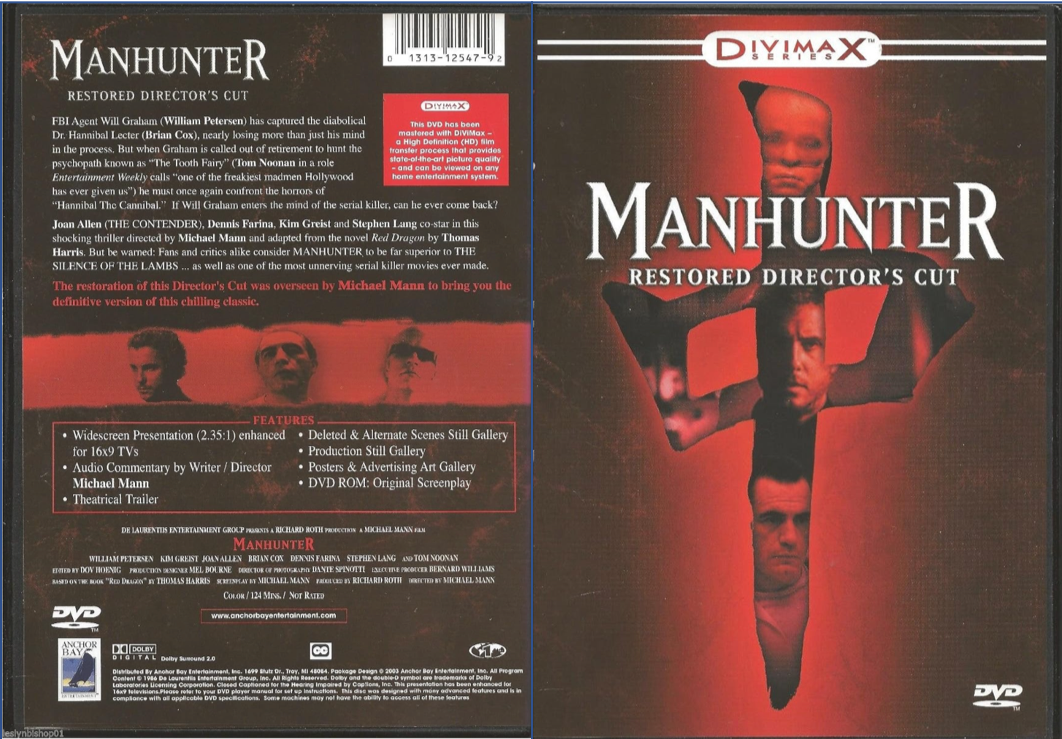
Finally, Anchor Bay intended for the new edition to promote its new line of DVDs called “DIVIMAX,” which entailed the process of creating a new high-definition “24-progressive-scan-frame transfer yielding 1,080 lines of resolution” allowing for higher video quality than previous DVD editions.7
In essence, one can view DIVIMAX as a precursor to Blu-Ray and HD-DVD in terms of digital video “quality,” which is typically measured by resolution. The new version was thus set up as technically and so qualitatively superior to the ‘average’ DVD. By getting Michael Mann to authenticate the reissue, denigrating the previous edition, and tying to the new transfer technology, Anchor Bay preemptively legitimized the “Restored Director’s Cut” as the new definitive version of Manhunter.
However, what Mann didn’t mention in that article for Video Store Magazine but later admitted on the film’s commentary track is that, in fact, the new cut had to use the same inferior one-inch masters for a good deal of the director’s cut footage due to the negative not being preserved by its production company.8
““One of the things that became difficult for us was to find some of the pieces of negative. Traditionally, those pieces are preserved and saved by studios and… in the fortunes that befell the production company that made this picture, that wasn’t the case. So, so, uh, some of the missing pieces were constructed with, uh, one-inch masters from The Movie Channel version.”
Source: Michael Mann, Audio Commentary at [1:59:20], Manhunter Restored Director’s Cut DVD.
This becomes rather obvious as you watch the film, because whereas both previous Anchor Bay Cuts had consistent quality from shot-to-shot, the Restored DC vacillates between the glossy, high-quality look characteristic of the former and the grainier, VHS-like quality of the latter, making a seamless viewing experience impossible.
Reviews commonly evaluated the transfer of the new cut as stronger overall in comparison to that of the previous edition, but pointed to how the director’s cut footage looked quite inferior to the theatrical - more noisy, grainy, with signs of artificial enhancement, especially in the additional director’s cut scenes.
“As a general rule, those scenes from the movie’s theatrical cut have a fairly good and consistent quality of appearance, while those scenes added for the director’s cut look noticeably worn down, grainier, faded, and often damaged. Many times the quality will even jump from shot to shot within a scene…. All that said, the Restored Director’s Cut is a tremendous improvement over the last Director’s Cut DVD, which was almost totally unwatchable. The worst, most damaged scenes in this disc may look like crap, but they are an eminently more palatable flavor of crap than the last disc. ”
Review by Joshua Zyber, DVDFile, July 8 2003
In fact, the only additional scenes that appear in high quality comparable to the theatrical scenes are the same three scenes that previously showed up in the Anchor Bay Hybrid Cut: the realtor scene, the Molly hotel scene, and the extended scene of Will entering the victims’ house in his imagination.
From this, it becomes evident that the “superior master” copy Mann touted in his interview was the same copy Anchor Bay initially used to create the Hybrid Cut for the 2001 DVD. This would make practical sense - rather than spend time and effort to create a new transfer and/or master copy, Anchor Bay could reuse what was already there and likely at the time constituted the highest quality source material available.
“This presentation of MANHUNTER was personally supervised by Michael Mann and contains footage not available in the original theatrical release. Although of less than of optimum quality, this restored footage was mastered from the best available elements. We hope any imperfections you observe will not detract from your enjoyment.”
Source: The opening disclaimer of the Restored DC DVD
Additions and Subtractions
The end product’s massive qualitative gap between the theatrical version’s footage and the director’s cut footage, is ironic, for in terms of editing, the Restored DC attempts to find a middle ground between its predecessors. All the additional scenes that Mann previously reinstated for the Showtime DC are still in the Restored DC, save for one: the meeting between Graham and Dr. Chilton right before he first visits Lecktor. Its excision improves the pacing and shortens the director’s cut by 1m 27s, making the film move directly from Will calling Molly to the Lecktor scene.
At the same time, Mann seemingly walked back some of the microscopic trims he had made previously for the Showtime DC, restoring about 1m 7s of bits and pieces from the theatrical version, which is why the Restored DC is only 20 seconds shorter.
Notably, the Restored DC still leaves out what many fans of the film consider a crucial bit of dialogue from a sequence, where Graham and Jack discuss the Tooth Fairy killer’s motives while watching the home videos of his victims, about ¾ into the movie.
In the cut passage, which lasts about 45s., Graham expresses empathy for the killer, who had clearly been a victim of child abuse, much to Jack’s surprise. Its absence, alongside many minor or insubstantial additions and alterations, is one of the primary reasons why many consider the theatrical cut to be the best version of the film.
Higher Re-Definition
The BluRay Director’s Cut
Despite Mann and Anchor Bay’s best efforts, the Restored DC didn’t quite become recognized as the definitive version of the movie. Putting aside that its editorial changes were met with a mixed reception, its technical presentation still clearly left much to be desired and one can infer that Mann himself was not all that happy with the end result due to the lack of celluloid source material for the extra footage.
Nonetheless, the Restored DC seemed to have replaced both preceding Anchor Bay Cuts in circulation, insofar as it is the only cut alongside the theatrical to have made it to Shout Factory’s “Collector’s Edition” BluRay in 2016.

One of the selling points of the new release was that it presented the theatrical cut in high definition (presumably using a pre-existing master copy). The presentation of the director’s cut, meanwhile, was plagued by the same issues that plagued the 2003 DVD - the lack of celluloid source material for the additional footage.
Unable to create a new HD transfer as a consequence, Shout decided to compromise by presenting a standard definition port of the Restored DC alongside another variant of it that switched back and forth between HD for the theatrical footage and SD for the director’s cut footage. Needless to say, the gaps in video quality, which were already visible on the 2003 DVD, were only magnified by the HD Blu-Ray variant!*
*Naturally, all the sequences that looked well in the 2003 edition, including the Molly and Realtor scenes from the Hybrid Cut, were presented in proper HD.
In the era of high definition video formats like BluRay and 4K Ultra HD, the director’s cut became again virtually unwatchable. Unable to keep up with the times and the technology, it was doomed to obsolescence. All this brings us to…
The Final Cut
Back in November 2023, in my article on the director’s cut of Blackhat and Mann’s penchant for revisionism, I talked a little about Manhunter, as I’d read a rumor that the film was planning a new cut and restoration for release in 2024. I thought the rumor was credible, especially as Mann had recently admitted to being motivated to revisit older movies by new technology, and it would make sense for him to restore the film again if he’d located the source material for the director’s cut footage.
“But he was never really satisfied with how the film’s extra footage looked because it was sourced from a low resolution videotape…. If this is indeed another cut and is being restored, then it’s possible Mann has finally found a celluloid source for the extra footage he wanted to integrate into Manhunter.”
Flashforward to June 2026, about 2 years after the expected date of the rumored reissue, and Manhunter: The Final Cut is formally announced by Studiocanal for the film’s 40th anniversary. As it turns out, I was right. The celluloid source was found.
The very fact that it’s getting a brief run in THEATERS should tell you how confident Mann and Studiocanal are in the quality of this version’s technical presentation. The trailers and the elaborate press release really want you to know that this is a truly satisfying, fully immersive, quality-consistent director’s cut of Manhunter.
Remastered, Not Restored
Contrary to what StudioCanal claims, however, this is not a “4K Restoration.”
Calling it as such is highly misleading. Manhunter was not really restored, because the negative of the theatrical cut was never really lost or damaged. Rather, it was remastered, meaning a new 4K Scan of the original celluloid negative was used to produce a new video master copy, from which then new 4K BluRay copies could be made of both the theatrical cut and final cut.
The only parts of the negative that were previously lost were the ones containing the director’s cut footage. And it’s likely those parts still haven’t been found, as a careful reading reveals that the Final Cut was actually composed of two sources: the original negative and an interpositive.
Given everything that I know about the movie’s history, I am quite certain that the director’s cut footage for this variant was, in fact, wholly derived from the latter print. In fact, I’m willing to bet it was the discovery of this interpositive that enabled the production of the Final Cut in the first place.
What this means is that the added footage in the Final Cut is again likely to look somewhat inferior to the theatrical footage. Nonetheless, an interpositive print is a major step up from the 1-inch videotape masters used previously and allows for a mostly consistent viewing experience from scene to scene.
Films Always Change
Of course, it would be unusual for Mann to NOT take the opportunity to once again tinker with the edit. My understanding, based on his own comments, is that he had once again gone through the picture with a fine-tooth comb and made various tiny trims and other adjustments to existing scenes, while reinstating much of the same deleted footage that had appeared in the previous iterations of the director’s cut.
I’m particularly curious if Mann has indeed put back in the cut dialogue from the theatrical version about the Tooth Fairy having been abused as a child. Some of the comments he made during a Q&A recently seem to support this:
“...the genius of Graham is that he can… that sense of having empathy and sympathy for a victim who is produced into being a devil and at the same time loathing the actions. And as he says in the line, he’s an adult, you blow the sick fuck out of his socks, and holding both of those at the same time.”
Source: Michael Mann, Post-screening Q&A, June 12 2026
Mann has not hidden the fact that he wants this version to work for a contemporary audience and has taken steps to modernize it, such as by removing what he considers “outdated” dialogue and updating the color grade. In this regard, Manhunter, like James Cameron’s The Abyss, foregrounds the paradox of digital preservation, which is that a film must be modernized in order to be preserved and remain acccessible.
“…Mann worked with his long-time collaborator, Stefan Sonnenfeld (Company 3), to develop a new color grade for ‘The Final Cut’ that engages a contemporary audience while honoring the film’s lasting legacy.”
Source: StudioCanal Press Release, June 12 2026
“There’s unfortunate lines of dialogue that I had an opportunity to excise….We wanted to render into a visual aesthetic that is contemporary to the palette of colors it would have now.”
Source: Michael Mann, Post-screening Q&A, June 12 2026
Every new director’s cut of Manhunter replaced the one preceding it, with the 4K Final Cut simply being the latest iteration of the director’s cut that first came out in 1988 on TMC and a successor to the 2016 Blu-Ray release. Its particular situation is not fundamentally different from that of any other film that circulates on video.
As our home viewing technology continues to evolve over time, successive editions of the same picture continuously supplant the ones that came before. Mann is simply making the ongoing cycle of renewal and obsolescence more visible by recutting the picture in addition to technically enhancing it. Even if there was only ever one cut of Manhunter, there would still be multiple versions of it distinguishable by aspect ratios, levels of audiovisual “quality,” and other platform-specific characteristics.
Indeed, it would not surprise me if an 8K edition of Manhunter (its theatrical cut at least) comes out some time in the next decade to replace to 4K Final Cut.
The Final Cut may be the final cut but it’s almost certainly not the final edition.*
* Anybody interested in seeing the Final Cut in theaters can find a list of screenings here. Additionally, if you want to own it on video, you can pre-order a 4K and regular BluRay combo release by DiabolikDVD. This is a 4-disc limited edition featuring some new bonus features including a 100-page booklet and a featurette on the “restoration” of the film.
The larger revision history it is now part of illustrates the fact that films are not stable and unchanging works, but rather fluid texts that constantly transform over time in response to various factors, such as vision of a director evolving, the development of new technologies that enable revision or require it for the sake of access, the changing of ownership or the opening of new markets and distribution platforms. It is only natural for new versions of a film to arise, while older ones fade into oblivion.
But what do you think?
Is there truly an “authentic” or “original” version of Manhunter? Which of the availably cuts is your favorite, and why? Is Michael Mann, in fact, doing something wrong by repeatedly tinkering with it? Does the ability to change a film make a director comparable to God (if you get the reference)? Do you think that movies are inherently fluid texts or unchanging works of art?
Interested in reading more about the revision history of a Michael Mann film? Then check my article “10 Butchered Movies that Never Received a Director’s Cut“ for Taste of Cinema, where I talk about The Keep by clicking below:

Variety 323, no. 17 (Jun 11, 1986): 45.
The Urbana Daily Citizen, Aug 15 1987, 10.
"`Manhunter' on TMC." Los Angeles Times, Dec 31, 1987.
Jim Emerson, "Trailers," Orange County Register, Jan 10, 1988.
John J. O'Connor, "TV VIEW; TV's Film Editors Giveth as Well as Taketh," New York Times, Jun 12, 1988, Late Edition (East Coast).
Lucas, Tim. “Michael Mann’s MANHUNTER: Spread Your Wings and Learn to Die.” Video Watchdog 13 (Sept/Oct 1992): 24-29.
Enrique Rivero, "Michael Myers Returns in New Edition of John Carpenter's Classic 'Halloween'," Video Store Magazine 25, no. 33 (Aug, 2003): 24.
Mann alluded to DEG having filed for bankruptcy in 1988 and dissolved in 1989. This is likely why the DVD releases have proven so problematic, as the various source materials for the movie were likely dispersed among different owners not too long after the film came out.
Meanwhile ..‘The Keep’. Paramount cut around 30 minutes of the film without permission from Michael Mann.
If you have any insight, I'm dying to know - I know Mann not only re-cuts his movie for every format, but will use CGI to smooth over things - with all the other things he changes, why does he leave the jump cuts in? Like, the one with Lecktor in his cell on the phone, the camera's right on his face, and Mann will jump cut, I presume to maintain performance. I recently saw a newer version screened at the Egyptian in L.A., and the jump cuts were still included. Any notion why he doesn't use CGI to smooth those jumps out? I assume he likes having them there?