
On TWBA, Yuki's Revenge and One-Film Supercuts of Two-Part Movies
PLUS: FTNC and More Revisio-News

I’ve finally seen Kill Bill: The Whole Bloody Affair (TWBA) a recut of the two-volume Tarantino epic that I’ve been waiting for over 20 years, and that got me thinking a little about two-part movies and the potential for one-film supercuts.
So, in this scrapbook, I’m going to talk about all of that alongside some other stuff, including interesting things I’ve discovered about the “lost chapter” short film Yuki’s Revenge, which was released on YouTube before appearing after TWBA in theaters.
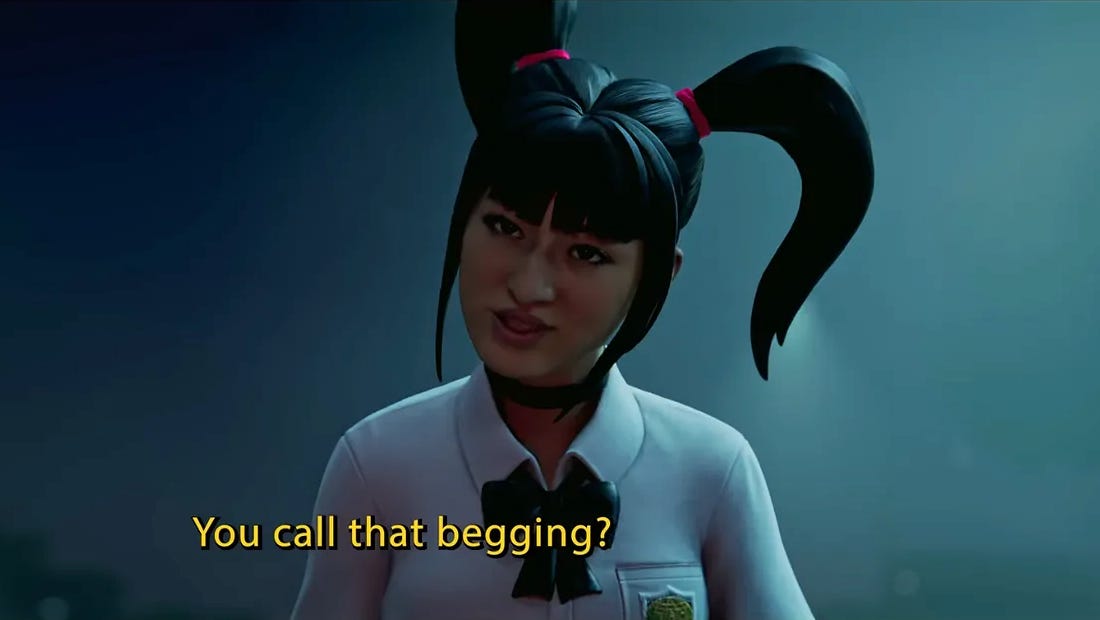
Table of ContentsRevisio-News
Please consider subscribing and receive any new post for free via email, or upgrading to a paid subscription to support this publication.
Kill Bill TWBA Impressions
The final cut of Kill Bill has left me with somewhat mixed feelings.
On the one hand, I really enjoyed seeing the film as a whole. Kill Bill really is more than the sum of its parts and works better as a singular experience. By far, the biggest and most significant difference between this and the split two-volume version is the lack of the Volume 1 bookend sequences, which gave away the fact that The Bride’s daughter is still alive. It’s such a great twist at the end of the movie, one that the preceding 3+ hours are building to. I’d say it was worth the price of admission.
Still, there were things that bothered me.
I couldn’t find a quality screening venueThe ideal format to see this cut would be 70mm. Unfortunately, there weren’t any theaters equipped for 70mm and so I had to settle for the regular local mall theater showing. And, if you’ve been paying attention my writing about the decline of movie theaters, you might guess that the quality of the screening was really low.
The digital projection had muddled colors and repeated instances of bitrot showing up all throughout, as though the film was damaged in the course of transmission.
And this, once again, makes me feel worried about the future of theatrical exhibition. Because I doubt audiences will feel incentivized to see films in theaters, when the standard quality of the presentation keeps falling.
The new anime sequenceI was really hyped to see the new 7-minute O-Ren Ishii anime segment, which I’ve written about previously. Unfortunately, the end result was somewhat disappointing. Rather than an elaborate, over-the-top action sequence, it’s more of a low-key if bloody coda, one that the movie works fine without.
I’m curious how I will feel about it upon rewatch, assuming that TWBA indeed makes it to home video. One issue was that the new material just looked poorly framed and calibrated due to the exhibition issues I mentioned above, so maybe I just couldn’t enjoy it as much as I should have due to the break in immersion.
RedundanciesBy far, what most surprised me is that Tarantino still kept the black-and-white driving scenes in TWBA, with the first one functioning as an opening and the second popping up as an additional credits sequence right after the initial Malagueña Salerosa credit scene. My going theory was that this was always a side effect of the film being split in two. That is, I assumed the opening driving scene and the driving credits sequence were made so Volume 2 could work better as a standalone film, while Malagueña Salerosa was the original credit sequence meant for the film as a whole.*
*Admittedly, the first driving scene no longer recaps the events of Volume 1, but still…
In the context of TWBA, I just don’t really see the point of both keeping in the Driving Scenes and the Malagueña Salerosa Credit Sequence. If the former were fully cut, while the latter remained, or vice versa, that would be to the film’s benefit.
On Yuki’s Revenge
With all that out of the way, let’s talk about “Yuki’s Revenge,” the weird little animated Fortnite short that functions as a kind-of post-credits scene to TWBA (and is likely the reason why its running time was reported as 4 hours 41 minutes).*
*A few days prior to the release of TWBA, the short appeared on YouTube for free and can be seen here.
This ‘lost chapter’ of Kill Bill, is a fun and entertaining, if completely unnecessary, romp.* The Bride’s showdown with Yuki Yubari, the sister of the psychopathic Gogo, is an extended action sequence and one that is quite different from any other battle in Kill Bill. Whereas the movie proper features a lot of sword-fighting and martial arts, Yuki’s Revenge has a full-on gun battle. I like how it embraces the outlandish and cartoonish aspects of the format it’s made in: bullet wounds result in what look like bits or cubes of data getting shot out rather than blood and Yuki keeps drinking a drug made by Bill, the effects of which are visualized with hand-drawn animation.
*Honestly, my biggest issue with it is the fact that Tarantino performs a really poor imitation of David Carradine’s voice in the opening scene.
Interestingly enough, the short was adapted almost verbatim from an early, unused draft of the Kill Bill script (which is why, as far as I’m concerned, it doesn’t fit into the continuity of the final film). In this iteration of the story, Yuki Yubari is introduced in Chapter 4 as Gogo’s 16-year-old sister, who leaves the House of Blue Leaves early due to having caught a cold. After The Bride takes out O-Ren, a devastated Yuki then pursues her to California in Chapter 5, catching up with her shortly after she has assassinated Vernita Green, as seen in the film’s opening sequence.
A few minor tweaks notwithstanding - like cameos by what I assume are Fortnite characters, eg. the banana guy - this short is pretty much a one-to-one translation of the “Yuki’s Revenge” chapter, which was completely cut from the final shooting draft.
What I discovered is that Yuki wasn’t entirely erased in the course of revisions though.
In the early draft, Gogo is a silent killer, who has no dialogue, nor any real scenes of character development. She duels The Bride with her Meteor Hammer weapon as per the final film, but has no interactions with her otherwise. By contrast, Yuki gets multiple scenes and interactions that establish her as a bonafide psychopath.
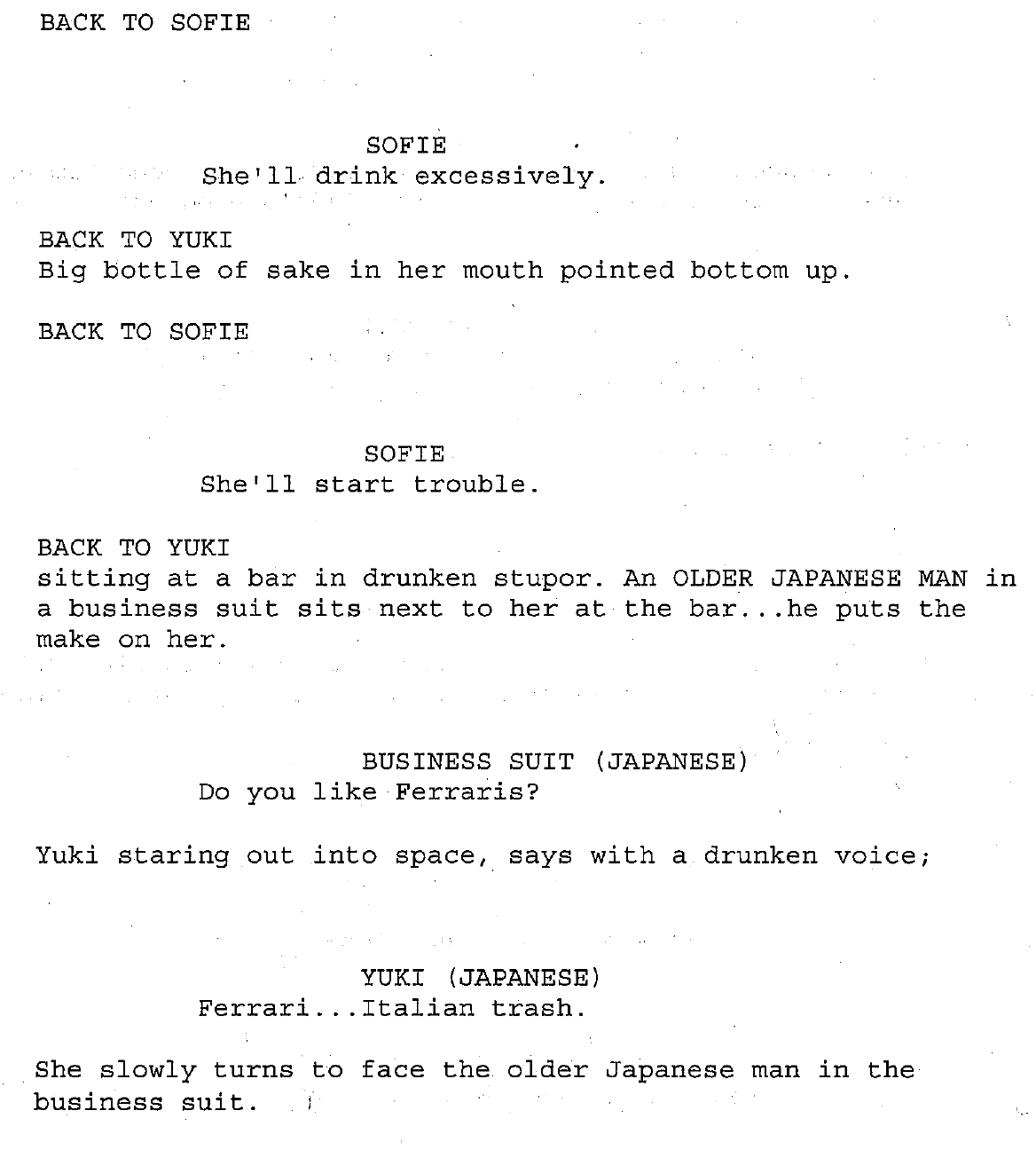
When the Bride interrogates Sofie Fatale, she asks what Yuki will do once she finds out about Gogo’s death. The film then cuts to show Yuki getting excessively drunk while grieving her sister and then disemboweling a Japanese Businessman.
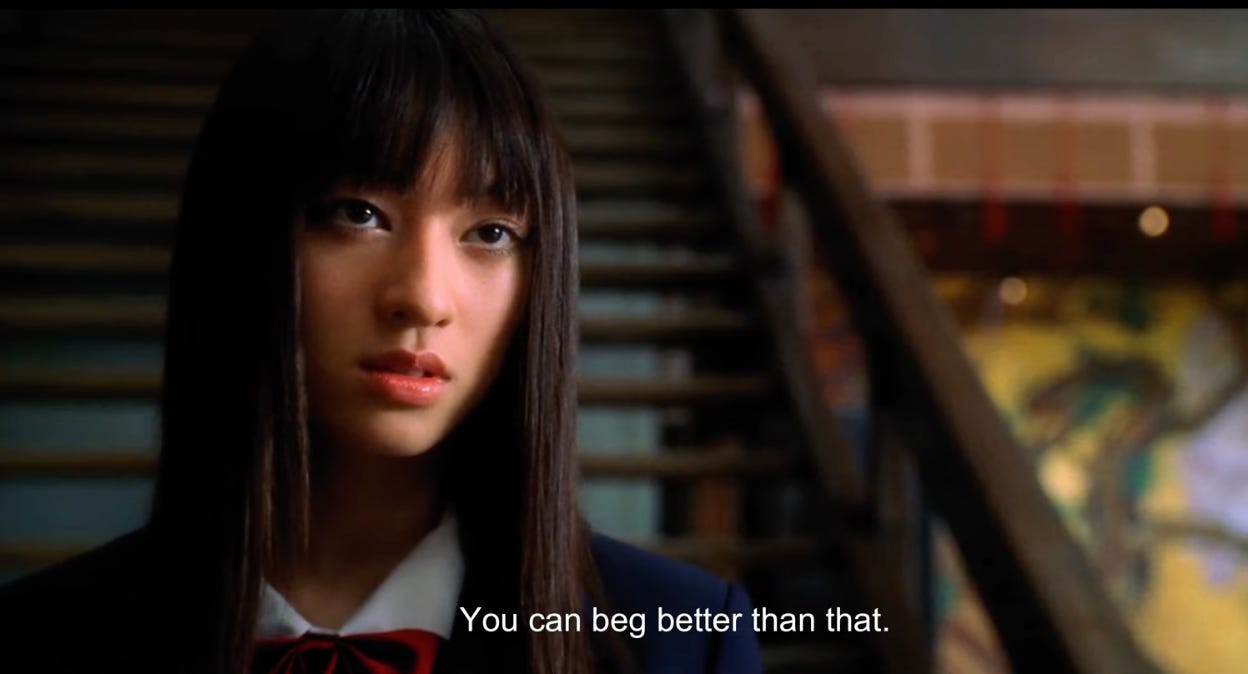
Along with Yuki’s characterization, that sequence would be repurposed for Gogo in the final film as a cutaway when she is first introduced as a member of O-Ren’s entourage. Some of Yuki’s dialogue from her first scene with The Bride would also be given to Gogo, who now has a short conversation with The Bride before attacking her.
In the earlier script, the Bride tells Yuki that she begs her to walk away, even as she wants to avenge her sister. In the final film, she tells Gogo that she begs her to walk away, even though she wants to protect her mistress.
In both instances, she gets the response:
“You call that begging? You can beg better than that.”
Basically then, Yuki and Gogo were merged into one character, with the final version of Gogo receiving Yuki’s characterization and key dialogue, while retaining her earlier iteration’s big martial arts fight scene in the House of Blue Leaves.*
*On a side note, O-Ren had another bodyguard in the early draft named Mr. Barrel, whom the Bride convinces to simply quit and walk away. His lines of dialogue about knowing The Bride as ‘black mamba’ and how ‘reputations precede us’ would also be reused for Gogo in the final film. Barrel would be replaced in the later drafts with Johnny Mo (Gordon Liu).
Combining the two Yubari sisters was a good choice from the standpoint of narrative economy. It helped Tarantino narrow down the script, as well as turn Gogo into a more interesting antagonist with a larger role… which makes it all the more baffling that Tarantino decided to revive Yuki over 20 years later for a short film and didn’t bother to make any changes to avoid redundancy with the main feature.
The Fortnite Yuki is basically the same character as the film’s Gogo, and the ‘begging’ exchange is still there, even though it’s already been used in the movie!
I like to thus view “Yuki’s Revenge” as a standalone, non-canon ‘what-if’ side story, one that shows how Kill Bill evolved and became a better, stronger film over time.
And who knows? Its existence could potentially signify more Kill Bill content in the future. Tarantino had a lot of unrealized plans for this film and its universe, after all.
Why Aren’t There More Supercuts?
The release of TWBA has made me more interested in checking out more single film supercuts of two-part movies. Given the recently developed tendency of Hollywood studios to produce two-part films, especially adaptations of popular novels, one would expect there to be a bunch of supercuts available on streaming and video platforms.
Surprisingly though, that hasn’t been the case.
In fact, I’ve come to realize that supercuts are actually quite rare.
For instance, there was a version of The Godfather that combined Part 1 and Part 2 into an extended 7-hour long film that aired on HBO about 10 years ago but isn’t available anymore in any single format, unless you count the VHS versions of the 70s television version that you might be able to find on Amazon and Ebay.
More recently, there was the 225-minute Baahubali: The Epic (dir. S.S. Rajamouli), an Indian action film that combined Baahubali: The Beginning (2015) and Baahubali: The Conclusion (2017). I hadn’t seen either of the two parts, but was intrigued by the idea of seeing the shortened supercut, which received a theatrical release here in the US back in November. At the time, I couldn’t find any local theater that played it but fortunately, the remastered, recut version has been released on Netflix this Christmas, so I’m going to check it out if I have the time and maybe share my impressions later.
Other than this, I’ve only found discussions of supercuts that have yet to be made.
Back in 2019, director Andy Muschietti spoke of his interest in creating an extended 390-minute supercut that combines the horror opus It (2017) and its sequel It Part 2 (2019) with additional footage cut from the films and new material that hadn’t yet been shot. To date, this still hasn’t happened, though during a recent Reddit Q&A, the director has reiterated the desire to make it, claiming he hadn’t had the time due to his involvement with It prequel series Welcome to Derry.
““We call it the supercut,” Muschietti explains. “It’s very early stage, you know, and we’re still discussing the format. It won’t be intertwined or anything like the way it’s in the book. But it will contain all the scenes that were deleted from both movies for pacing reasons, and we’ll hopefully have new material, which is stuff that I haven’t shot yet.””
Source: Consequence of Sound
More recently, director John Chu revealed plans to potentially make a single 5-hour supercut of the hit musical Wicked (2024) and its sequel Wicked For Good (2025).
Unlike the It films, these two were shot back-to-back as part of a singular production before being divided into two parts for theatrical release, which suggests it might be much easier to re-edit them into a single feature.
“Do you want, one day, to have both films released as a five-hour movie with a 15-minute intermission where people can watch them in a movie theater together? Is that something that interests you?
CHU: Absolutely. I’m maybe one of the very few people, including the studio — I don’t think the studio’s done it, but I’ve done it — both my editor and I, we’ve watched both back to back, and it is a whole new experience. It’s great. It is wonderful.”
Source: Collider
All in all, I’d say supercuts are something of an untapped market. They have the potential to provide a whole new experience, a new way of watching.
Which makes one wonder: why aren’t there more of them?
What do you think?Why aren’t there more supercuts out there? Is it too expensive or time-consuming to put them together? Are there any two-part movies you think could be successfully recut into a single feature? Is there a market for more such recuts? Please,
Revisio-News
Nightmare Alley director’s cut
Nightmare Alley (2021) is, in my mind, one of Guillermo del Toro’s best movies. After the disappointing Crimson Peak (2015) and really overrated Shape of Water (2017), this was a return to form. If you ask me, del Toro is a great visualist but his works tend to falter at the script level. That, however, is not the case with Alley, which couples del Toro’s breathtaking style with a really strong screenplay.*
*The ending of the film in particular feels like a pitch perfect final note for its story.
Though it garnered plenty of accolades, Alley was released at a time when circumstances made it impossible for a film like this to make any real money at the box office. After Covid, audiences were very selective about what they were willing to see in theaters in December 2021, and it didn’t help that the film opened against the behemoth that was Spider-Man: No Way Home.
Nonetheless, it seems primed for a strong shelf life. In January 2022, a longer black-and-white director’s cut called Vision in Darkness and Light, which was about 10 minutes longer than the theatrical, was released in select theaters.
This past October, the film had a swanky Criterion Collection release that combined the two versions in one package, while around the same time, the director’s cut made its way to streaming via Disney Plus and/or Hulu.
I haven’t seen the director’s cut myself yet, but I think a b/w version is apropos, given that the picture is a kind-of throwback to film noir.
So, I’d recommend checking it out if you haven’t already.
An extended Avatar 3?
You don’t bet against James Cameron.
This is the fourth time in a row that he’s released one of the most expensive movies ever made (not adjusted for inflation), only to blow past industrial and critical expectations. I don’t know if Fire and Ash will gross over two billion dollars, but I think it’s pretty much guaranteed to pass 1.2 billion and generate a profit, which could very well happen by the time this post is published.
With its release, James Cameron has finally completed his own trilogy. That’s an achievement in and of itself. I mean, it’s kinda rare for the same director to make all three installments of a mega-budget blockbuster franchise.
Avatar, in that sense, is Cameron’s answer to Star Wars and Lord of the Rings.
Oh, sure, some will continue to argue that this franchise has “no cultural impact,” even though two of its films thus far have won Academy Awards for Best Visual Effects and its influence can be seen all across the film industry.*
*Avatar was key to selling exhibitors and audiences on the transition to digital pro-jection as well as standardizing 3D and IMAX 3D as regular viewing formats.
I personally thought the first film was the weakest in this burgeoning saga, but never thought it was bad by any measure. Way of Water, meanwhile, was among the top tier of Cameron’s oeuvre, a sequel that surpassed the original in pretty much every way.*
* It helped that, instead of writing the sequels all by himself, Big Jim got a bunch of screenwriters together in a room, then spent years translating his ideas into scripts before shooting a single frame. Cause, let’s face it: Cameron is a better director than he is a writer. I personally really hope the fourth installment at least gets made, because its main screenwriter was Josh Friedman, who’s a favorite of mine.
Fire and Ash doesn’t quite reach the consistent greatness of Water. Some parts of it feel like a rehash of its immediate predecessor, and one gets the overall feeling that it’s holding back or running in place rather than pushing things forward in terms of story.*
But in other respects, Fire and Ash goes deeper and swings harder, muddling the moral lines that separated its heroes from the villains. It’s also the artsiest and most formally experimental movie Cameron has made since Terminator 2. This movie isn’t afraid to get weird and I’m hoping the next entry, assuming it’s completed, is even bolder.
*I strongly suspect that the repetition is attributable to the fact that Water and Ash were originally written as a single film, before Cameron decided to split them up into two movies during development as there was way too much going on. I am quite curious as to what exactly changed in the process - my theory is that Neteyam’s death was probably the biggest alteration and one that allowed Water to stand alone.
Naturally, every time a Cameron movie comes out, there’s a good chance it’ll get an extended special edition. Surprisingly, this hasn’t been the case for Way of Water, even though the first Avatar got something like 3 alternate cuts. But a special edition of Fire and Ash seems to be a bit more likely. In a recent interview with Collider, Cameron claimed to be “thinking” about a longer version and has mentioned there’s about 25-30 minutes of material that could be reincorporated into the picture.
If released, it would push the length of Avatar 3 to 220-225 minutes, which sounds rather close to the reported length of the picture’s assembly cut, which was around 4 hours. Cameron cut the film down by 45 minutes following test screenings but it sounds like he really likes a lot of the footage that was left on the cutting room floor.
“The film’s first assembly cut approached four hours. Viewers at an early test screening were enthusiastic (when asked if they would see the film again, Cameron says the entire audience raised their hands). But some griped about the film’s length.”
Source: Hollywood Reporter
Personally, I’m not sure what exactly could be added to the movie, in that it felt pretty complete. Cameron himself suggests that any additional material would be mostly character development rather than anything that advances the plot. I also think that, if a longer cut is made, it probably wouldn’t be that much longer simply due to the fact that restoring nearly 30 minutes to a super-expensive, VFX-heavy film like this today is commercially unfeasible. But in any case, I am eager to see what we get.
And who knows? Maybe the extended Fire and Ash will break the rule that the best Cameron Cut is always the theatrical one.
FTNC Updates
I’ve updated the Film and Television Newsletter Catalogs with three new entries. Substack has finally introduced a “Film and TV” category towards the end of last year, so the directory perhaps isn’t as viable as it used to be but I still hope it helps writers with discovery and will continue to update it gradually.


Final Notes
This will be the last post until the Spring, when T.V. will return with an extensive deep-dive article about what really happened to Sony’s underrated Morbius.
I’ve been working on this one on and off over the past couple of years and am very happy to be bringing it to completion. Currently aiming for March-April.
So, the gap will be long, but the wait will be worth it!
Thanks so much Mikhail!!