
Gunn’s Superman: Xenophobia, Misogyny, Moral Incoherence
The new movie is overrated.

As I watched James Gunn’s Superman, I had a whole bunch of thoughts.
I didn’t think it was a bad film, exactly, but I definitely found that it was overrated. In my mind, it is a very mid film, one that has good qualities but also a LOT of flaws.
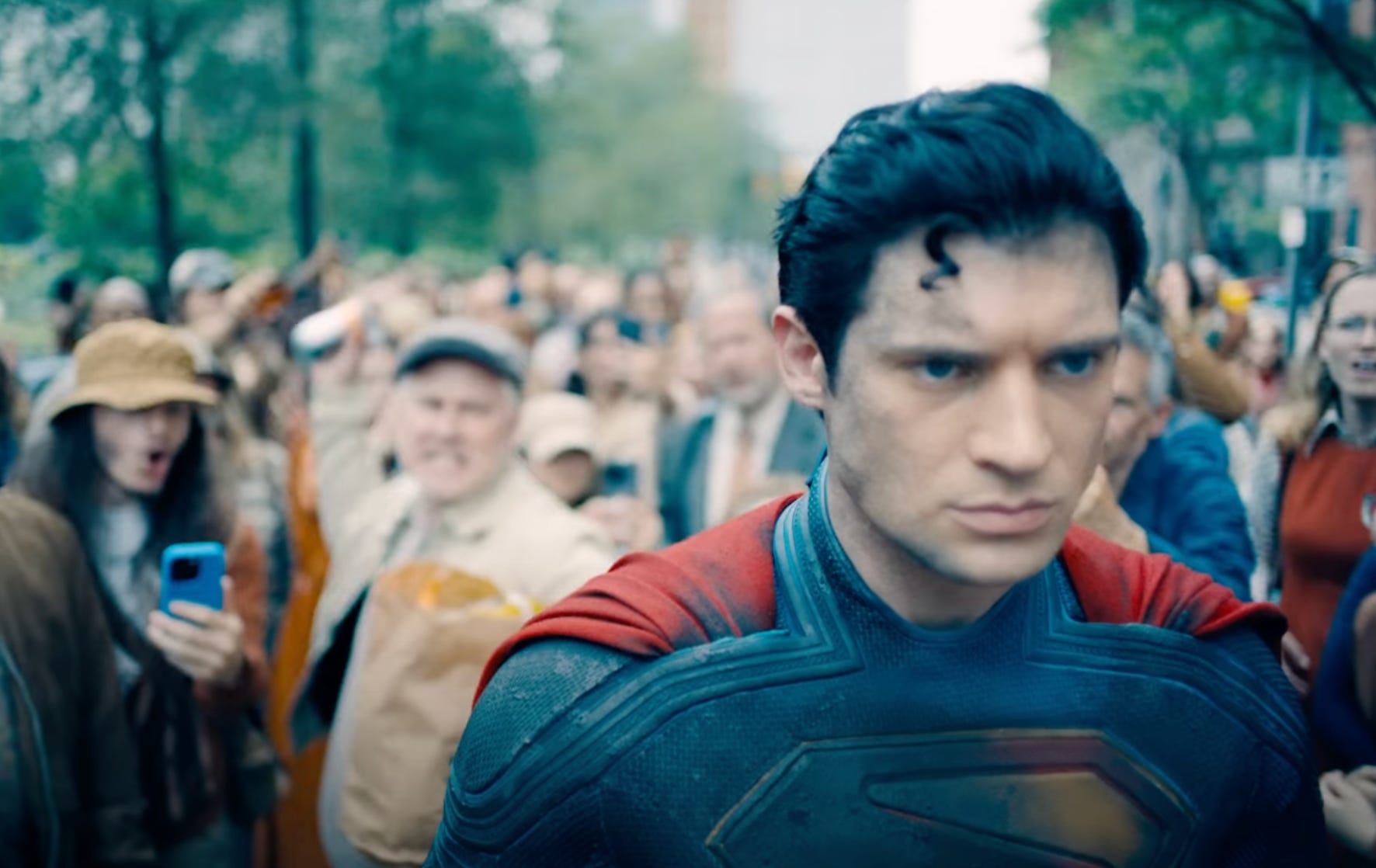
Table of ContentsPlease consider subscribing and receive any new post for free via email, or upgrading to a paid subscription to support this publication.
The Pros
First, I’ll talk about what I liked.
The casting is good. Korenswet and Brosnahan don’t actually have that much to work with, but they make for a likeable central couple as Clark and Lois respectively. Really though, the MVPs of this film are actually Edi Gathergi’s Mr. Terrific and Nicholas Hoult’s Lex Luthor, both of whom are scene stealers and arguably have the most confident narrative material at their hands. Lex especially is the kind of Luthor you want to see more of, as opposed to Kevin Spacey or Jesse Eisenberg.
I also admire the film’s visual variety. There is a lot of COLOR here, a lot of places and sequences that just pop off the screen, especially when you get inside the pocket dimension that Lex created to imprison anyone that stands against him.
I think the action here is largely nice if not exactly outstanding, the only exception being the sequence where Mr. Terrific really cuts loose with his spheres.
And I admire the overall ambition of the movie, which plunges the viewer into the middle of a different universe teaming with superheroes and all sorts of comic book weirdness. There is no origin story, either for Superman or the new DCU.
But for all that, there’s a lot that just didn’t work for me.
Misogyny and Xenophobia
For one thing, I think this movie is overstuffed. It seldom has any breathing room, and while it has plenty of emotional beats that land, it really seems to prioritize just moving from one point to the next, while trying to distract the viewer from the fact that it doesn’t really examine almost any of the ideas it tackles in any substantial way.
For another, I find Superman to be a weirdly misogynistic film.
This isn’t to say the film doesn’t have any well-drawn or likable female characters (eg. Lois Lane) but to highlight that it presents Eve Tessmacher as little more than a clueless bimbo, reduces Kat Grant to busty, walking eye-candy and makes Jimmy Olsen into an asshole that treats women like garbage (think Starlord without the redeeming qualities) without ever calling him out on his behavior.
More than that, I really, really don’t like how the movie depicts Superman’s parents. A key issue is that it never once bothers to really give audiences an actual understanding of what Krypton is, only suggesting that its inhabitants apparently view humans as an inferior species to rule and consider human women as potential sex slaves.
In theory, there is nothing wrong with this take on Superman’s parents. The problem is that their depiction - and thus the characterization of Kryptonians in general - is essentially rooted in xenophobic beliefs about Middle Eastern and Asian cultures.*
*Despite all the jokes, it is evident that the movie wants us to take the ‘secret harem’ thing at least on some level as a serious threat to the sanctity of human (that is, Western) society.
This, in turn, plays into the portrayal of the Kents as saintly, archetypal farmers that represent everything good and pure about the US. I’m quite certain for many viewers, this stuff would fly over their heads. But for an immigrant like myself, it stands out, especially as the film, for all its silliness and whimsy, does attempt to tackle topical issues like the immigrant experience.
Yet, in effect, what it ends up saying is that Superman is good in large part because he chooses to reject the backwards foreign upbringing of his biological parents and instead embraces the white, traditionalist American mentality of his adoptive ones.
To be a good immigrant then, you have to assimilate and give up that which is ‘bad.’
‘Man of Steel’ Reaction
By far the most interesting thing about Gunn’s Superman to me is how it feels like a conscious reaction to Zack Snyder’s take on Superman in Man of Steel (MOS, 2013), which itself was a reaction to Bryan Singer’s Superman Returns (2006).
You can see this in the bright, poppy, colorful look of the picture, the exaggerated and heightened “reality” of its setting or the comedic tone. But for me, this is most clearly visible in how the movie repeatedly underlines just how much this Superman aims to protect all forms of life, to the point where Gunn even includes a moment where Superman saves a freaking squirrel from being crushed by a Kaiju.
This is the moment where the movie basically screams at the audience: “See how much he cares?! This Superman cares about collateral damage! This Superman doesn’t just save people, he even saves cute little rodents!”
I doubt anybody familiar with the controversies that erupted after MOS came out would not see this as a direct response to how that movie handled the depiction of collateral damage and the false perceptions that Snyder’s Superman “doesn’t save anybody” or “kills more people than he saves.” Both claims are honestly bullshit (and were, in fact, debunked years ago) yet continue to be reiterated by people that rejected Snyder’s more relatively grounded approach to the character on general principle.*
*Despite all the buildings leveled in the climax, MOS notably never confirmed that those buildings were filled with people. As nobody died on-screen, the idea was obviously nobody died at all from the destruction. But social media disagreed, and so Snyder and co. chose to lean into the ‘collateral damage’ perception in the sequel. Since then, Superman’s cinematic battles have been confined to areas that have been evacuated or are confirmed to be uninhabited. The new Superman continues the trend.
Regardless, the new movie’s Superman is positioned culturally by the filmmakers as the comparatively “better” one by virtue of the fact that he wants to save everyone and never actually kills anybody. (This is why I think a lot of people overpraise the movie - it largely corresponds to their idealized model image of Superman, of what they believe the character should be or always has been.)
There are, however, multiple problems with this attempted (meta-)dialogue with MOS.
Moral Incoherence
To begin with, Superman’s moral position is not coherently depicted.
Even as the movie goes out of its way to establish that Superman saves doesn’t kill, it also establishes that he has no compunctions about threatening to murder a foreign head of state unless he complies with his demands. We don’t know for a fact if Superman would’ve made good on his threats and have lots of reasons to believe he wouldn’t, but doesn’t it seem out of character that this squirrel-saving hero also resorts to dictatorial, might-makes-right strong-arming tactics to get his way?
Or what about Superman’s attitude towards the film’s two main soldier villains, the Engineer and Ultraman? During the climactic action sequences, he appeals to the former, trying to convince her that she doesn’t have to follow Lex’s orders. But then he never tries to make any appeal to the latter. Even after discovering that his final foe is a mentally incapacitated clone of himself with not much in the way of free will, Superman never once tries to reason with nor show any compassion to Ultraman.
The way the movie dispatches the villain ultimately absolves Superman of direct culpability - Clark manages to get Ultraman hit by a building that flings him into a black hole - but provides no moment for him to reckon with this action, which leads to the presumed death of Ultraman, on an emotional level.
These problems also feed into the second major issue, which is that the movie itself seems to be at odds with the character’s alleged moral standing.
Consider the role of the Justice Gang.
Their presence early on expands our understanding of the world of the film, while also contrasting Superman’s ‘save everyone’ mentality with that of a more practical, down-to-Earth, and cynical group of heroes. That fight with the Kaiju, where the squirrel scene takes place, is very telling in that regard: where Superman wants to find a non-lethal way to stop the Kaiju, Green Lantern and company just want to kill it and be done. Moreover, while Superman just wants to ‘save lives,’ regardless of the geopolitical situation, the Justice Gang members are well aware of how bad it would look if they intervened in the Jarhanpur/Boravia conflict.
The ‘arc’ of the Justice Gang is ultimately to come around to Superman’s side when it comes to humanitarian interventionism. At the end of the movie, he calls upon them for help and they answer by going up against the Boravian army. And in the course of this, Hawkgirl directly attacks the Boravian government, taking its leader Ghurkos out into the sky. Ghurkos tells Hawkgirl something to the extent of: “I know you’re like Superman, so you won’t kill me.” And Hawkgirl replies that she’s not like Superman before proving her point by dropping Ghurkos to his death.
On the one hand, this underlines the distinction between Superman and the Justice Gang. Despite coming around to his way of thinking, Hawkgirl remains a more morally gray and cynical hero willing to go to lengths Superman wouldn’t. On the other hand, Hawkgirl’s actions conveniently dispatch the film’s villain without requiring Superman to get his hands dirty.
Superman is responsible for this death insofar as he spurred the Justice Gang to intervene. But the situation is contrived in such a way that he is again personally absolved of direct culpability and so never has to wrestle with the morality of his choices or the consequences of his actions.
All this effectively throws any claim the film has towards possessing a coherent moral framework out the window and so undermines the metatextual claim the film makes about the superiority of this take on Superman over that of Zack Snyder’s.
Sure, unlike his predecessor, Gunn’s Superman doesn’t directly kill anyone. Yet his actions do ultimately bring about death and promote a fascist-like authoritarianism.
I’m certain some people would defend the film against such criticisms by claiming that the inevitable sequel will interrogate the contradictions we see here or point to Flagg’s scene towards the end as evidence that the movie is deliberately avoiding a clear ideological or moral stance.
But I believe it’s crucial to analyze what the film is trying to say in and of itself. And from this perspective, the Flagg scene is another sign of incoherence. If there is a takeaway from all this, it’s that killing villains to protect the innocent is justified, so long as it’s not the pure and idealized good guys that carry out the killing.
But what about you? Do you agree with my take on the new Superman? Vehemently disagree? Am I wrong to read it as highly conservative, misogynistic and at times xenophobic?
Please let me know in the comments.
Similar or Related PostsSuperman represents an example of what I like to call a “faux-lo” movie, which is a crossover film that is billed as a solo superhero movie for marketing purposes. I discuss Warner’s strategy of such crossover-first, spinoff-second movies here:

Thanks for this excellent and nuanced review. I have not seen the film and now feel like I’ve had the best preview.
What this brings to mind is watching the early TV series of Mission impossible on our old black-and-white set in the 60s.
In every almost every Episode each Saturday night, the good guys arranged for the bad guy to perish either by his own hand through an arranged illusion or at the hands of other bad guys who are led to believe something like that the first bad guy betrayed them, which wasn’t true but too bad for him.
For me this pointedly demonstrated how to arrange a death without pulling the trigger yourself — and that this was the best way to deal with a bad guy.
I remember bringing this up in my social studies class and the teacher agreeing and being impressed. We all had the war on Vietnam on our minds then, as it was graphically reported on the television every day.
This was just a few years before the invention of Fox News by Roger Ailes who worked for the White House back then.
So the weekly moral Pretzel twisting on Mission impossible made a strong impression on me which comes to mind again while reading your good review.
Thank you.
This is an excellent review. I just watched it last night with my partner and we were both shocked by how all over the place this movie was! And I was disgusted by the portrayal of women.
Cat, the other female journalist that maybe says two lines, seems to just be there for objectification. Compare Lois and Cat's outfits throughout the film: Cat is dressed in a tight shirt that has the top two buttons undone, with a black skirt and tights, where Lois is "modest", wearing baggy pants and shows basically no skin. As a feminist, I think we should wear whatever we want without it meaning anything, sure, but since this is a movie, I have to wonder if Gunn purposefully had their wardrobes picked out to say "Lois represents the perfect female, look how she respects herself, and these OTHER women are dumb and slutty."
Eve's character was portrayed in such a mean spirited way that I genuinely had to consider if I like James Gunn at all now. She is a walking stereotype, made to seem dumb, materialistic, vain. "Look at this stupid girl, she wears a purple snowsuit! Look at this stupid girl, she takes selfies!" Her boyfriend, Lex Luthor, obviously treats her like shit because he's the villain. Okay, I'll take that, we're supposed to see Lex Luthor being an asshole, sure. But Jimmy also treats her horribly. Her name in his phone is "mutant toes" and he clearly doesn't like her or respect her, but promises to date her for information on Lex. So he uses her. But Gunn plays this all off like "isn't this so funny?" I didn't find Jimmy using her funny at all, it felt very sad to me.
We see Eve telling Jimmy she misses his mom, and that she wants to see her again (paraphrased, I don't remember exactly), and Jimmy might as well have broken the 4th wall to look into the camera to say "Look at this crazy bitch". I see a woman who's in an abusive relationship seeking out companionship from an ex that treated her better (supposedly) but here he is laughing at her!
It felt very dark to me. We see Lex throw a pencil at her, screaming at her to get out, and she runs and HIDES in a closet, crying, to talk to Jimmy, and Jimmy has no care in the world what happens to her. We just saw Lex shoot the falafel man in the head. Eve tells Jimmy something bad will happen to her if she narcs on Lex and Jimmy doesn't care. He calls LOIS to make FUN of her afterwards.
When the credits rolled, all I could think about was "Is James Gunn a misogynist? Why would he portray women like this?". I think the message Gunn was hoping to showcase certainly got lost in the midst of his annoyance for women he deems lesser.